
Long ago I decided to get Rolfed. It seemed to be an interesting way to radically change my posture with all of my perceived postural defects. It was the thing to do back in the day.
I wanted to achieve what’s called the Rolf Line.
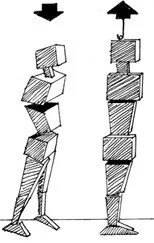
The analogy that Ida Rolf used was that our body should stack up like bricks with a line that goes through the ear, the shoulder, straight through the torso, down through the hip joints, knees and ankles.
I received a few Rolfing sessions from Ida herself, followed by sessions with some of her protégés. It worked. I did feel more relaxed, slightly longer, and my weight shifted back on my heels more than on the balls of my feet.
But I had some mysterious problems.
After taking a break from tennis, basketball, and a few other sports for about six months while undergoing my Rolfing sessions, I was startled to find what seemed to be much slower reflexes when I resumed those sports. I couldn’t move quickly enough to return serves and I felt weaker serving the ball. This same kind of symptom occurred with anything I did. I thought taking half a year off must have slowed me down and I just needed to practice more to regain my speed.

Photo by Marcos Paulo Prado on Unsplash
But I was wrong.
Soon after my Rolfing, I entered a training program of Dr. Moshe Feldenkrais’. It was his first four year training. Because I studied with him before the training, I became his first North American student. I explained to Dr. Feldenkrais that I had lost some speed in my reflexes and was having a difficult time playing tennis or basketball.
He simply asked me to swing a tennis racket a few times. Then he stopped me and said, “Your posture is all wrong for those sports. You’re stacked up like a pile of bricks with your weight too far back on your heels. Your posture is not suitable for the actions you need to make.”
He worked with me for about an hour. The next day, I returned to the tennis court and discovered that my reflexes were much faster. I was amazed.
I told Dr. Feldenkrais what had happened and he said, “If you’re too far back on your heels, it takes too much time to move the body forward or to the side. You need to have a posture that’s lined up more toward the front of your foot so you can move quickly. Or when you play basketball, so you can jump without spending the time to prepare your posture to jump.”
Rolfing gave me a static posture but I needed a dynamic posture.
At that time in my life, I couldn’t fully understand how moving my arms more quickly to hit a ball could have anything to do with my standing posture, but this sparked my curiosity and led me to becoming a movement scientist.
All posture is a preparation for actions, therefore posture can only be understood in terms of our relationship to some activity in the environment.
Through many decades of working with patients and students all over the world, I’ve learned how our posture will reveal itself in our movements as our movements reveal our posture.
All posture is a preparation for actions, therefore posture can only be understood in terms of our relationship to some activity in the environment. Those activities are determined by our intentions, our relationships to people, skills that we may have or perhaps had difficulty learning.
Most people hold onto the view of posture as a static alignment we organize in the trunk with the body as a set of bricks stacked up. However, what we usually label “good posture” often reveals rigidity in the trunk, spine, and ribs that requires considerable effort to maintain.
This effort becomes too difficult for many people to maintain and so they seek opportunities in which they can find relief in other postures, including more collapsed, slumped postures, which are hard on the spine. Both rigid and collapsed postures make it difficult to breath easily and create stiffness or disjointed sloppiness in our movements.
Instead of sticking with these old views, I needed to start thinking of posture in a new way.
I learned that the old idea of posture as a stack of bricks is inaccurate because we have a brain. We tend to think that our brain conforms to the structure and parts of our body. This is only partially true.
The greater truth is that the body must conform to the habits of the brain. For example, while we stand, our brains process feedback from our senses — our eyes and our vestibular system — to strive to maintain a horizontal position for the head. This is true even if our spine has extreme curvatures of lordosis (an extreme lumbar curve) or scoliosis. Our brain will try to move our spine to maintain a horizontal head position unless we are practicing a sport skill or a particular dance.
One of the most important contemporary understandings of our posture is how much it is designed and assembled by the brain.
But where in our brain is our posture? No one has found a specific location in the brain for posture. This is because posture is distributed throughout our brain and creates greater meaning for all movements we perform.

If you want a to hit a golf ball, there is an assumed position in which you are standing. There also must be an orientation for your position (probably the golf ball and where you are hitting it). Within these layers of position and orientation lie our postural habits and finally the variety of specific whole body movements that comprise hitting the ball.
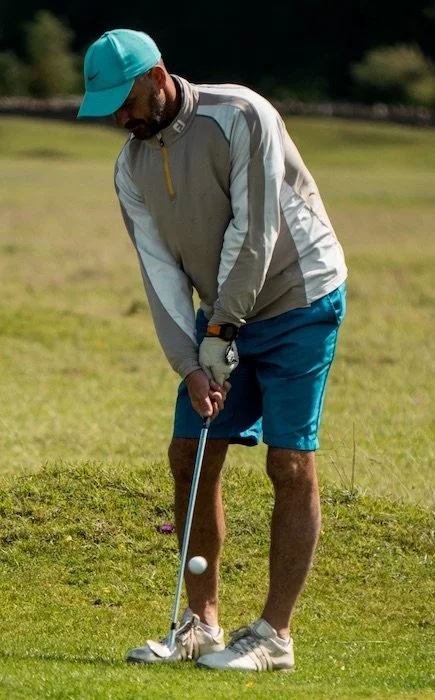
Photo by Matt Seymour on Unsplash
The posture you would take to drive from the tee is different from the posture you need to chip up a slope to a slanted green or to putt.
Your brain determines your posture. What you sense or feel at any particular moment, as well as your intentions to perform actions in relation to your environment — all of these things require a different posture.
Ideal posture is ideal in relation to the actions you want to perform.
Your posture is only as good as it serves your intentions and actions.
If you are interested in working privately — either in person or via teleconference, please email me at frank@frankwildmanmovement.com or call 510–283–5494. Visit our product page for more information on the Change Your Age and Intelligent Body audio lessons and books.